
Quick Answer
A foam pump makes foam by forcing a thin liquid and air through a fine mesh — it does not thicken anything. So it only works with a low-viscosity formula (a diluted, water-thin liquid), and it needs a wide-mouth foam bottle, not a standard bottle. Get those two right and the rest is straightforward: pick an output (0.5–1.2 cc), match the bore (28–43 mm) to your bottle, and choose the materials. Done well, one press aerates the liquid 5–8 times and cuts product use by 30–50%.
How a Foam Pump Makes Foam
A foam pump has two parts a plain lotion pump doesn't: an air-liquid mixing chamber and a fine foaming net. Press the head and it pulls a measured dose of liquid and a charge of air into the chamber, then forces the mix through the net. The mesh shears it into tiny, even bubbles and expands it five to eight times into dense foam. Nothing is added — the foam is your liquid plus air — so two things follow directly: the liquid has to be thin enough to pass through the net, and the net itself sets how fine and stable the foam is. Those two facts drive every choice below.
Get the Formula and Bottle Right First
This is where foam-pump projects go wrong, so it comes before anything else.
Your formula has to be thin
A foam pump has no thickening power. It pushes liquid and air together through an internal foaming net, so the input has to be a low-viscosity, water-thin liquid — usually a concentrate diluted with water. Hand soap, facial cleanser, sanitiser, mousse, and shampoo work because they can be thinned. A rich cream, gel, or oil will not pass through the net cleanly and will clog it. If your product cannot be diluted to a thin liquid, you need a lotion pump or cream pump instead — see the dispensing pumps guide for the full comparison.
Test dilution early. The same pump gives different foam with different dilutions. Before you lock a design, send your actual formula for a foam test — this is the single most useful thing to do, and it is free with a sample request.
You need a foam bottle, not a standard one
Foam pumps draw more air, so they sit on a wider neck than a normal lotion pump. Our foam pumps fit standard foam bottle mouths of 28, 30, 40, 42, and 43 mm and pair with PET or HDPE foam bottles from 150 ml up to 650 ml. A regular narrow-neck bottle will not seal or foam correctly — plan the pump and bottle together.
When Foam Actually Wins
Foam is not just a texture choice. The reasons to switch are concrete:
- Less product per use — aerating the liquid 5–8 times means a dose goes further and cuts liquid consumption by roughly 30–50%, which lowers cost-per-use for the end customer.
- Ready to use, no rubbing — foam lands pre-lathered, which suits no-rinse sanitiser, kids' and baby washes, and anything used quickly.
- Perceived premium — dense, stable foam reads as higher quality, which is why cleansers and mousses use it.
If none of these matter for your product and your formula is already thick, a standard dispensing pump is the simpler choice.
Reading the Spec Sheet
Once formula and bottle fit, three numbers and one material list decide the pump.
| Spec | Ruijiong options | What it decides |
|---|---|---|
| Output per press | 0.5, 0.8, 1.0, 1.2 cc (liquid base) | Foam volume per pump. Lower for facial cleanser and travel; higher for hand wash and shared dispensers |
| Bore / bottle mouth | 28, 30, 40, 42, 43 mm (plus 24/410, 28/410) | Must match your bottle neck. Larger bores suit bigger bottles and higher output |
| Materials | Body PP · net nylon · seal silicone · spring stainless steel | The nylon net sets foam fineness; the stainless spring sets feel and lifespan |
| Colour | White, pink, green, blue, transparent, electroplated | Shelf look; electroplated reads premium |
The output figure is a liquid-base measure — the amount of liquid drawn per press, which then expands into foam. Match it to how the product is used, not to the biggest number.
All-plastic vs stainless spring: the standard build uses a stainless-steel spring for feel and durability. If you need a fully recyclable, mono-material pack or you're packaging a corrosive liquid, ask about a metal-free version — the spring is the part that blocks easy recycling and can corrode.
Matching the Pump to the Job
Foam pumps are tuned by application. Picking the variant built for your product saves a round of sampling.
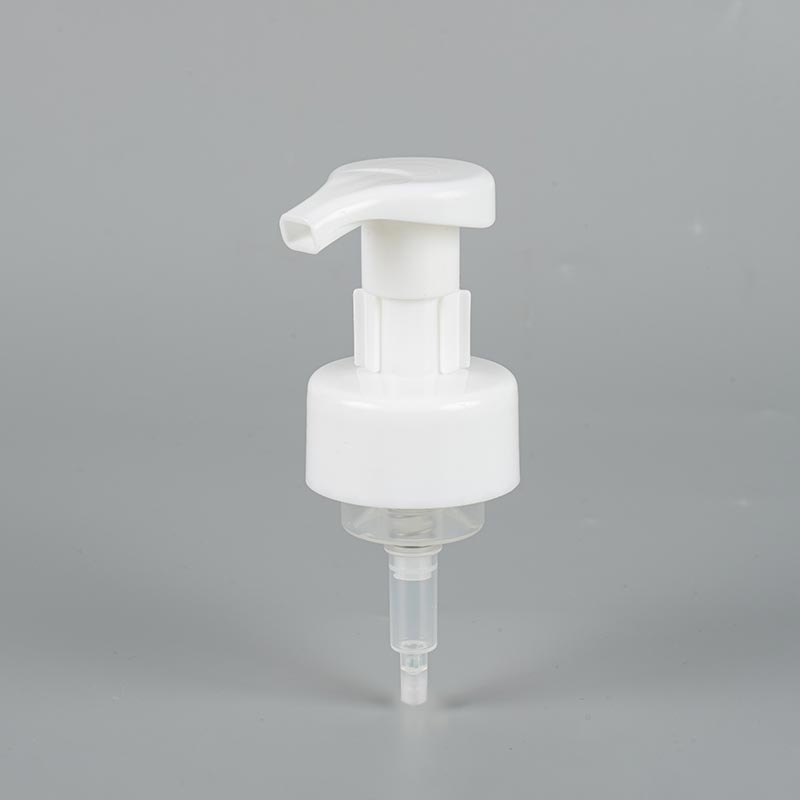
Multi-Spec Foam Pump — 24/410 and 28/410, PP/PE compatible; the default for soap and cleanser.
Standard cleanser & soap — Multi-Spec Foam Pump
The general-purpose choice for foaming hand soap, facial cleanser, and sanitiser. Mainstream 24/410 and 28/410, compatible with PP/PE bottles. See the multi-spec foam pump.
Face, shoe & pet cleaning — Foam Pump With Brush
Combines the foam head with a soft, food-grade brush, so foam and scrubbing happen in one step. Built for facial cleansing, shoe washing, and pet care. See the foam pump with brush.
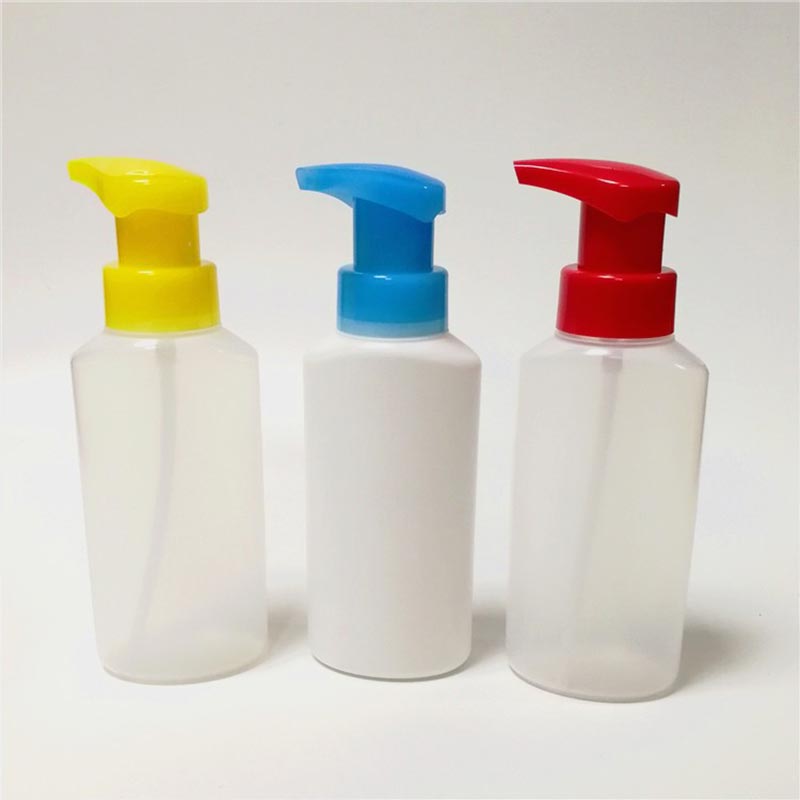
Hair-Care Foam Pump — 40/410, fine light foam for mousse and styling foam; head is interchangeable with the original.
Mousse & styling foam — Hair-Care Foam Pump
Designed for mousse, foam hair wax, and styling foam, with a fine, light foam and quick rebound. Fits 40/410 and can replace the original pump head. See the hair-care foam pump.
Cleaning products — 2-in-1 Shoe Cleaner Foam Pump
A dense-foam cleaner head aimed at removing yellowing and stains, with a universally replaceable head. See the 2-in-1 shoe cleaner foam pump.
Fixing Weak or Collapsing Foam
Most foam complaints trace back to a handful of causes. Here is what actually fixes each — useful whether you're diagnosing samples or writing a spec.
| Symptom | Usual cause | What to spec / check |
|---|---|---|
| Thin or collapsing foam | Coarse or single-layer mesh; formula too thin/too thick | Double-layer precision foaming net; re-test dilution |
| No foam / sputtering | Not enough air drawn in | Enlarged air-intake channel; confirm bottle seal |
| Inconsistent foam press-to-press | Weak or fatigued spring | High-elasticity spring rated for repeat use |
| Clogging over time | Net blockage from viscous or residue-heavy liquid | Thinner formula; larger air channel; flush-friendly design |
| Hard to press / early failure | Poor head geometry; low cycle rating | Ergonomic head (about 30% less effort); 2,000-cycle lifespan |
| Leakage | Weak sealing | Silicone sealing ring; leak test before shipment |
Our foam pumps carry these fixes as standard — a double-layer net, enlarged air intake, high-elasticity spring, an ergonomic head rated to about 2,000 presses, and a silicone sealing ring — and each unit is performance-tested before it ships.
Sourcing Foam Pumps from Ruijiong
Ruijiong (YUYAO Ruijiong Daily Necessities Factory) has manufactured sprayers and daily-chemical and cosmetic packaging since 2018, selling direct as a factory. Foam pumps are food-grade PP with a silicone seal and a waterproof design that keeps water out in bathroom use.
Practical sourcing facts
- Free foam test — up to 10 sample units per batch at no charge; send your real formula so we can verify foam quality before you commit.
- Full variant range — standard, brush, hair-care 40/410, and shoe-cleaner heads, in six stock colours including electroplated.
- In-house tooling — 10 Haitian injection-moulding machines, 3 pump-core testers, and 4 assembly lines, so custom colour and OEM tooling stay in one place.
- Lead time — 15–20 days once the order and payment are confirmed, settled by 100% T/T. MOQ depends on spec and customisation; some lines start from 10,000 units.
Frequently Asked Questions
Will a foam pump work with my formula?
Only if your formula is a thin, low-viscosity liquid — usually a concentrate diluted with water. A foam pump aerates liquid through a fine net (a 5–8x foaming rate); it cannot foam a thick cream, gel, or oil. Test your actual formula with a sample before committing.
Do foam pumps need a special bottle?
Yes. Foam pumps sit on a wider neck than lotion pumps. Ruijiong foam pumps fit foam bottle mouths of 28, 30, 40, 42, and 43 mm and pair with PET or HDPE foam bottles from 150 ml to 650 ml. A standard narrow-neck bottle will not seal or foam correctly.
How much product does a foam pump save?
Because it aerates the liquid 5–8 times, a foam pump delivers a full lather from less liquid — roughly 30–50% less product per use than a non-foaming pump, which lowers cost-per-use.
What output should I choose?
Ruijiong foam pumps offer 0.5, 0.8, 1.0, and 1.2 cc per press (liquid base). Choose a lower output for facial cleanser and travel sizes and a higher output for hand wash and shared dispensers. Match it to how the product is used, not to the largest number.
Why is my foam pump not foaming or collapsing?
The usual causes are a coarse or single-layer mesh, not enough air intake, a weak spring, or a formula that is too thick or wrongly diluted. Specify a double-layer foaming net, an enlarged air-intake channel, and a high-elasticity spring, and re-test the dilution.
How long does a foam pump last?
Ruijiong foam pumps are rated for about 2,000 press cycles and use an ergonomic head that needs roughly 30% less effort, with a silicone sealing ring to prevent leakage.